

Park Light Price | Tall Metal Poles, Direct from Manufacturer Takshidfam
Park lights are designed to light public spaces, parks, sidewalks and large villa grounds. This product usually has a taller pole than a garden light and must withstand impact, harsh weather and long-term use; to see the full range of models, visit the park lights category.

Factors Affecting the Price of Park Lights
01 — Tall pole for wide light coverage
The greater pole height of this product spreads light over a wider radius, which suits internal streets, public sidewalks and the entrances of large complexes.
02 — Metal body and impact resistance
Because it is installed in public or busy spaces, a metal body (die-cast aluminum) resists impact, scratches and harsh weather better than plastic bodies.
03 — Use in gardens and large private grounds
In villas and large gardens, this product is used instead of in a public park to light the entrance drive or large grounds. To compare with more decorative options, also see villa lights.
04 — Classic model at a fair price
Classic models with a lantern design on a tall pole give public paths or grounds an elegant, traditional look without a significant increase in price.
05 — LED version for outdoor spaces
In public projects where lights must stay on for long hours, using LEDs reduces electricity costs. For smaller spaces, area lights are a good complementary option.
06 — Installation and pole foundation
Because of its taller pole, this product needs a stronger concrete foundation than ground-level lights so it stays stable against wind and impact. Installation by a technical team or with guidance from Takshidfam experts is recommended.
07 — Durability in public projects
In public spaces, the chance of vehicle impact, vandalism or extreme weather is higher; that is why this product’s sturdy metal body and electrostatic powder coating are a more reliable choice than lighter models.
08 — Which projects is it suitable for?
Park lights are a good option for municipalities and civil works contractors, large residential complexes with internal roads, and large villas with long entrance drives. For project orders, free technical advice on the right number and spacing of lights is also available.
How to choose the right model?
To choose the right park light, consider the following:
- Is your project private (villa/garden) or public (park/streets)?
- What pole height is needed to fully cover your space?
- Will the product be exposed to vandalism or heavy traffic?
For large projects, get free advice from our sales experts.
Park Light Price from the Manufacturer
The price of this product depends on the pole height, body material and type of light source. For villa or public projects, contact Takshidfam sales experts to get an exact price and bulk discount based on quantity and area.
Anatomy of a park light: what does each part do?
Before comparing models, it helps to know what parts a park light is made of. Knowing these parts helps you ask for exactly what you need when requesting a quote, and later, if a part is damaged, replace only that part rather than the whole assembly.
- Base plate (flange): the plate at the very bottom that is bolted to the foundation and transfers all wind load and weight to the ground.
- Pole or shaft: the vertical part that determines the mounting height. In classic designs it is usually decorative and multi-piece, and in modern designs plain and uniform. The cable runs up inside it.
- Arm or bracket: the part that holds the light head away from the pole axis. The shape of the arm (upturned, downturned or crook) changes both the appearance and the direction of light.
- Light head: the housing that contains the socket or LED module, internal wiring and sealing gaskets.
- Globe or diffuser: a clear or frosted cover that protects the light source from rain and dust and spreads the light; it is made of UV-resistant polycarbonate or glass.
In Takshidfam’s classic line, the body is made of die-cast aluminum with oven-cured powder coating and has an E27 socket, which means you can change the lamp yourself. In the modern line, the LED light source sits inside an aluminum body with a polycarbonate diffuser.


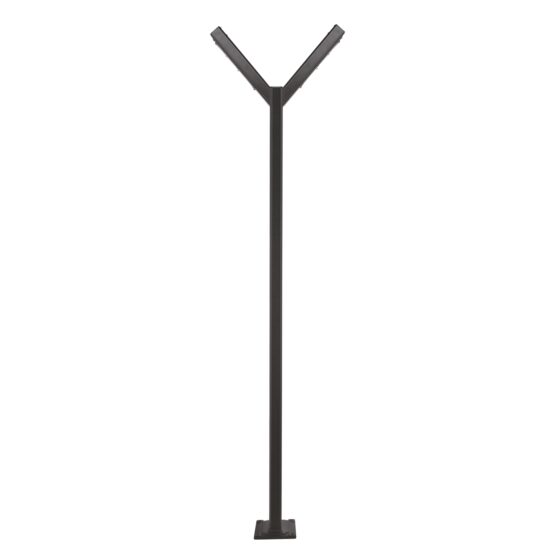
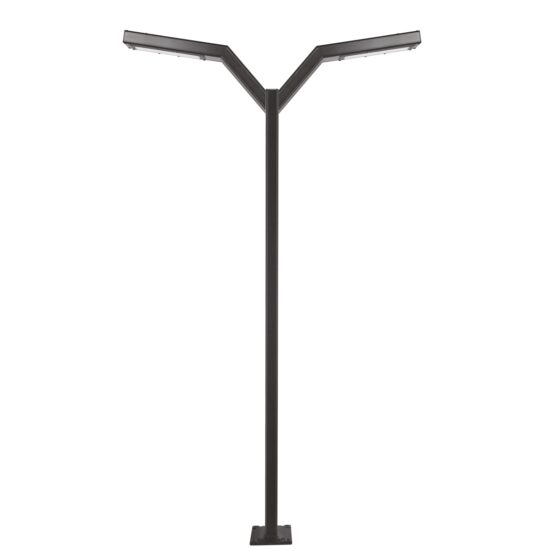
Single-arm, double-arm or multi-arm?
The number of arms is not just a decorative matter. A single-arm or post-top model (where the light head sits directly on the pole) suits the edges of paths and flower beds. A double-arm model sends light in two directions and is used in the middle of a complex’s internal boulevard or on an island between two paths. In squares and wide open spaces, a three- or four-arm model covers a larger area with one pole and reduces the number of foundations and cable runs.
Remember that every extra arm increases the weight and wind-exposed area of a park light; so the pole and foundation of a multi-arm model must be correspondingly stronger.
How to determine pole height and installation spacing?
The two figures with the greatest effect on lighting quality and project cost are pole height and the spacing between poles. The numbers below are common rules of thumb, and the final choice depends on the lamp type, globe shape and conditions of each project.
- Match height to the width of the space: for footpaths and villa yards, a pole of about 2 to 3 meters is usually enough. For internal streets of complexes and larger open areas, heights of about 4 meters and more are used.
- Estimate spacing from height: a common rule is spacing of about three to four times the mounting height. If you have chosen a frosted globe or a dimmer lamp, reduce the spacing.
- Start from critical points: first plan a pole for the entrance, path intersections, steps and bends, then fill the gaps in between evenly.
- Don’t forget the trees: the crown of a mature tree can completely block a light. Place the pole outside the tree’s canopy or at a height below where the branches begin.
Layout matters too: on narrow paths, one-sided installation is enough; on wider paths, a staggered layout on both sides gives better uniformity. If you are unsure about the height of your park lights, sending a simple sketch to our experts via the contact and consultation page is the quickest way to the right figure.
Foundations, anchor bolts and cabling in plain language
Most problems seen in grounds a few years later — a leaning pole, power cuts after rain or an electrified body — come not from the light itself but from its groundwork. Leave this part to the electrical and civil contractor, but knowing the principles helps you supervise.
Foundation and anchor bolts
The foundation is a concrete block poured into the ground, with several threaded anchor rods (anchor bolts) set in it before the concrete cures. The bolt spacing must exactly match the holes in the base plate; that is why it is best to get the drilling template from the manufacturer before pouring. The block size depends on the pole height, soil type and how windy the area is, and must be calculated for tall poles.
- Place the cable conduit in the center of the foundation before pouring the concrete.
- Install the pole after the concrete has fully cured and check it with a level.
- Finish the concrete surface slightly above the soil and lawn so irrigation water does not collect at the base plate.
Cabling and safety
The supply cable must be suitable for direct burial and run inside conduit, at sufficient depth and away from where the gardener digs. Make connections inside a waterproof junction box or with a special joint, not with electrical tape. The metal body of every park light must be connected to an earth wire, and the grounds lighting circuit must pass through a residual current device. On long runs, also consider voltage drop when choosing the cable cross-section.
Periodic maintenance: small tasks with a big effect
A park light does not need much care, but a few simple inspections a year preserve its appearance and light for a long time:
- Wash the globe with water and mild detergent; do not use thinner or rough scouring pads, as they scratch the polycarbonate surface.
- Check the sealing gaskets when changing the lamp and replace them if they are dry or cracked.
- Check the base plate bolts and arm joints once a year.
- If the body paint gets scratched by an impact, touch up that spot promptly.
- Replace a burnt-out lamp with one of the same color and wattage as the others so the row of lights stays uniform.
Takshidfam supplies its products with an 18-month warranty and guarantees spare parts supply for up to 10 years. This way, if a globe or arm of a model is damaged years later, the same part can be obtained and the look of the row of lights is not disrupted.
Common mistakes in purchasing and installation
In landscaping projects a few mistakes are repeated again and again. Review this list before finalizing your park light order:
- Choosing from a photo only: a light that looks delicate in a photo may get lost in large grounds or, conversely, look too bulky in a small yard. Read the actual dimensions in the catalog.
- Tall pole with a weak lamp: the greater the height, the less light reaches the ground. Choose height and lamp wattage together.
- Pouring concrete before receiving the base plate drawing: the result is bolts that do not match the holes.
- Mixing white and yellow light: using lamps with different light colors in one row makes the grounds look messy.
- Ignoring spare parts: buying a product without parts supply backing means that when one globe breaks, the whole set becomes mismatched.
- Omitting the earth wire to save money: this directly affects people’s safety and is not negotiable.
To compare designs, see the complete collection of park and area lights and check each model’s dimensions in the catalog and price list. If your grounds also need lower lighting beside flower beds, combining park lights with garden and lawn lights gives a more balanced result.
Frequently Asked Questions about Park Lights
The price varies with pole height and body material; call for an exact quote.
The villa model usually has a more attractive, decorative design, while the public model focuses on durability and resistance to vandalism.
Yes, special prices are offered for volume and project orders; call for details.
With a die-cast aluminum body and powder coating, this product lasts more than 10 years under normal conditions.
Yes, for project and bulk orders, an in-person visit to see a product sample at the factory can be arranged.
Request a Quote for the Right Park Light Now
Takshidfam sales experts are ready to provide purchasing advice and an exact price for your private or public project.